
Interested in being a voice for conservation? Join me in reaching out to your legislators!
Over the past year, Mississippi Valley Conservancy has been honored to welcome current and prospective legislators to our nature preserves to share our perspectives and experiences on conservation priorities. These visits have provided opportunities to discuss issues ranging from Farm Bill funding for managed grazing, the Knowles-Nelson Stewardship Fund, the role of the Wisconsin Conservation Congress, and the MariBell Transmission Line.
We are fortunate to have the leadership and support provided by Gathering Waters, Wisconsin’s alliance for land trusts, in facilitating and promoting these legislative tours.
These tours remind me of a presentation I gave several years to a local college’s Environmental Studies class. During the Q & A afterwards, a young woman asked “What is the single most important thing we should be doing for the environment?”
I had a one word answer. VOTE!
Afterwards, several students said they were taken aback by that, expecting the answer to be about recycling or planting trees or picking up litter. There are immeasurable things a person can do to benefit wildlife and conservation but voting and influencing decisions at the state and national policy level has far-reaching impacts to support conservation at local, regional, and national scales.
Our role as a non-profit conservation organization is not to lobby or raise money for one candidate or another or one cause or the other, but to provide all candidates with firsthand knowledge of what we observe on the landscape and the concerns we hear from the landowners and communities we serve.
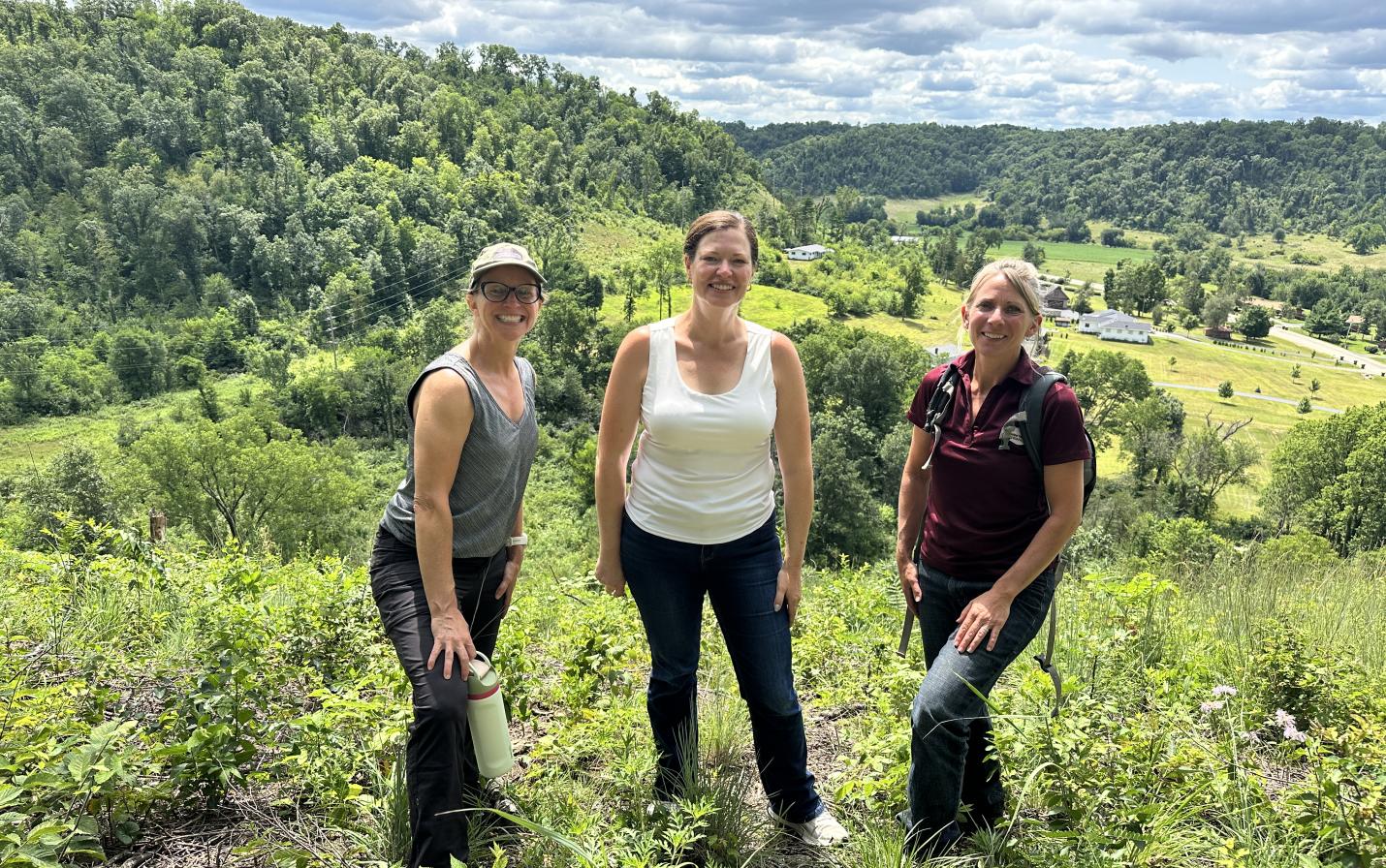
Recently, Gathering Waters’ Chief Strategy Officer Charlie Carlin joined the Conservancy's Abbie Church and Shane Drey at Boscobel Bluffs State Natural Area with Wisconsin Representative Jenna Jacobson. Boscobel Bluffs and our most recent acquisition of Bald Bluff were both made possible, in part, by the Knowles-Nelson Program. The two properties combined provide 475 acres of unusually high biodiversity offering resilience to a changing climate. They also demonstrate the value to the local community of Conservancy nature preserves providing hiking and hunting opportunities while simultaneously providing a home for area wildlife.
Jenna has been a vocal advocate and supporter of the successful bipartisan conservation program that has not been renewed by our legislators. Jenna is a prospective candidate for Wisconsin Senate District 17, representing Mississippi Valley Conservancy’s southern-most two counties, Crawford and Grant and our legislators will have an opportunity to revive the Stewardship Program. From Boscobel, we headed to the Wisconsin River to celebrate Woodman Floodplain, another site made possible through the Stewardship Program. Woodman Floodplain is our only nature preserve that is designated by the Ramsar Convention as a wetland of international importance. This unique complex of wetlands, southern wild rice marsh, and floodplain forest also offers the advantage of expanding a contiguous corridor of protected habitat with the adjacent DNR owned and managed lands. From there, we headed north to Crawford County.
Our tour concluded at Plum Creek Conservation Area (PCCA) where we joined Conservancy Restoration Ecologist Michael Reitz in showcasing the value of managed rotational grazing and showing the benefits of incorporating drought tolerant native prairie into the grazing system. The planted prairie was humming with bees, butterflies, and other pollinators and the deep-rooted compass plant, yellow coneflower, big bluestem and others were fulfilling their role of holding soils in place and rebuilding the soil organic matter. There we discussed agricultural needs and trends on this site as well as with the landowners the Conservancy is working with.
Jacobson is the ranking member of the Assembly Committee on Agriculture and has authored and co-authored several bills in support of family farmers. A portion of Plum Creek Conservation Area is enrolled into the farm bill Conservation Reserve Program CP-38 specifically to support pollinators and utilize native tallgrass prairie to build soil organic matter to improve water absorption, soil health and retention. Charlie and I also shared concerns over the environmental impacts of the proposed 765 kilovolt MariBell transmission line. The powerline being proposed will be larger and more impactful than any other utility corridor in Wisconsin and will impact landowners, wildlife, and habitat in both Crawford and Vernon Counties.
Telling the story of the conservation needs of the Driftless Area has immeasurable benefits in letting politicians know what the landowners we represent are concerned about and where decreasing wildlife populations need our support the most. Nothing changes by keeping quiet; the legislators we’ve met with welcome your input, whether through a phone call, an email, a letter, or a meeting. Your voice is a critical part of shaping our own future.
The more voices in conservation there are, the better we will all be heard. If you want to know who to contact, here is the link to a page where you can enter your address and get the contact information for all of your representatives.
(Above: Shane Drey (left) and Abbie Church (right) hike to the top of Bald Bluff with Jenna Jacobson as they discuss the importance of protecting native habitats across the Driftless Area. (Photo at Boscobel Bluffs State Natural Area by Charles Carlin of Gathering Waters.)